
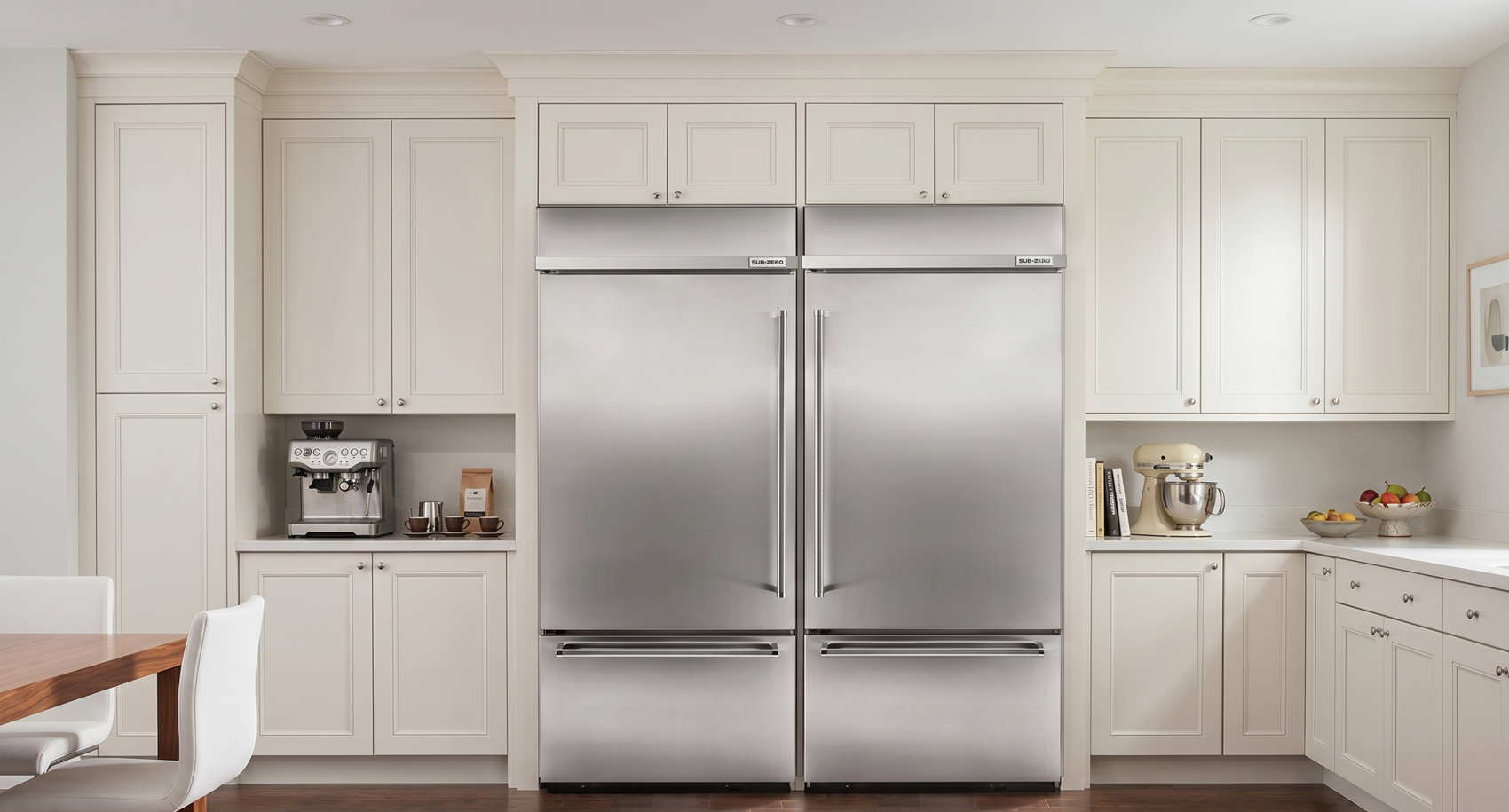
If your freezer is still working fine but your fridge section is warm, you do not necessarily have a dead appliance. In most cases, the cold air is being made just fine in the freezer, but something is preventing it from reaching the refrigerator compartment. That is a fixable problem, and below we walk through the most common causes we see across Folsom, Granite Bay, Fair Oaks, and the rest of our service area.
This is one of the most common refrigerator service calls we get. Some causes you can troubleshoot yourself in 10 minutes. Others need a technician. We will tell you which is which.
1. Blocked Air Vents Inside the Refrigerator
Modern refrigerators do not make cold air in the fridge section. They make it in the freezer and push it through vents into the fridge compartment. If those vents are blocked, the cold air never gets to your food.
Open the refrigerator and look at the back wall and the top of the compartment. You are looking for small plastic vent openings. If a cereal box, a Tupperware container, or a stack of leftovers is pressed up against those vents, the air has nowhere to go.
Pull everything away from the back wall by at least two inches. Give it 12 to 24 hours to recover. If the fridge starts cooling again, that was your problem.
Question to Answer: Are any of the vents in the back or top of your refrigerator blocked by food containers?
2. A Failed Evaporator Fan Motor
The evaporator fan is the small fan inside the freezer that blows cold air from the freezer into the fridge section. When the fan fails, the freezer stays cold because the cold air still sits in there, but the fridge warms up because nothing is moving air into it.
Open the freezer and listen. A working evaporator fan makes a soft whirring sound. If you do not hear anything, or if you hear a rattling, clicking, or chirping noise, the fan motor is likely the problem.
You can also press the freezer door switch with your finger while the door is open. That tells the fridge the door is closed, which should make the fan run. If nothing kicks on, the motor is bad or there is a wiring issue.
Replacing an evaporator fan motor is a technician job on most modern fridges. The freezer needs to be cleared out and the back panel removed.
Question to Answer: Can you hear a fan running inside your freezer when the door switch is pressed?
3. Frost Buildup on the Evaporator Coils
The evaporator coils sit behind the back panel inside your freezer. Under normal conditions, the defrost system melts off any frost that builds up on them. When the defrost system fails, frost builds up until it forms a solid block of ice over the coils. That block of ice traps the cold air and stops it from circulating to the fridge.
The clue here is a freezer that is colder than normal and a fridge that is warmer than normal. If you remove the back panel inside your freezer and see a solid sheet of frost or ice on the coils, the defrost system has failed.
A temporary fix is to unplug the fridge for 24 to 48 hours with the doors open and a few towels on the floor to catch the melt. That clears the ice. But the underlying defrost problem will come back unless the actual failed part gets replaced.
Question to Answer: Is there visible ice or frost buildup on the back wall inside your freezer?
4. A Stuck or Broken Damper Control
The damper is a small flap between the freezer and the fridge that opens and closes to control how much cold air flows into the fridge. If the damper is stuck closed, no air gets through. If it is stuck open, the fridge gets too cold and may freeze your food.
Some dampers are manual, controlled by a dial inside the fridge. Others are automatic, controlled by a small motor and the main board. A damper failure is one of the harder problems to diagnose without taking the unit apart, but it is a common cause when the fan is clearly running and the vents are clear.
If you have already checked the vents and confirmed the evaporator fan is working, the damper is one of the next places to look.
Question to Answer: Have you ruled out blocked vents and a failed evaporator fan as the cause?
5. Defrost Timer, Heater, or Thermostat Failure
The defrost system has three parts that can fail: the timer or control board that tells the system when to run, the heater that melts the frost, and the thermostat that monitors when defrost is done. Any one of these can go bad and cause frost to build up on the coils.
Diagnosing which part has failed requires a multimeter and access to the back of the freezer compartment. This is where most homeowners stop troubleshooting and call us. The good news is that defrost components are usually inexpensive parts. The repair cost is mostly labor.
If your fridge is more than seven or eight years old and the defrost system has failed, we will tell you whether the repair makes sense or whether replacement is the better call. That is part of our $60 service call.
Question to Answer: Is your fridge more than seven years old, and have you had similar problems before?
6. The Condenser Coils Are Caked With Dust
The condenser coils are on the back or underneath your fridge. They release the heat that gets pulled out of the food compartment. When they are coated in dust, pet hair, and kitchen grease, they cannot release heat efficiently. The fridge runs longer and harder to compensate, and eventually the cooling capacity drops.
This usually causes the whole fridge to run warm, not just the fridge section. But on borderline cases, the freezer can still keep up while the fridge section starts to slip.
Pull the fridge out from the wall and vacuum the coils with a brush attachment. If your fridge has them on the bottom, the kick plate pops off. Do this every six to twelve months as preventive maintenance.
Question to Answer: When was the last time the condenser coils on your fridge were cleaned?
7. When to Stop Troubleshooting and Call Us
If you have checked the vents, listened for the fan, looked for frost buildup, and cleaned the coils, and the fridge is still not cooling, it is time to call. Defrost system failures, sealed system problems, and control board issues are not DIY repairs.
We service refrigerators across Folsom, Granite Bay, Fair Oaks, El Dorado Hills, Carmichael, Roseville, and Gold River. We work on all major brands, including Sub-Zero, Wolf, Viking, Thermador, Miele, GE, Whirlpool, KitchenAid, Samsung, LG, Maytag, Kenmore, and Bosch.
The service call is a flat $60, applied toward the repair. Most repairs are completed same day or next day. Call or text (916) 335-0358 to schedule.
Question to Answer: Have you exhausted the DIY checks above and confirmed the problem is beyond what you can fix yourself?
In Summary
A refrigerator that is not cooling while the freezer still works is almost always an airflow or defrost problem. Start with the easy checks: clear the vents, listen for the evaporator fan, look for frost buildup, and clean the condenser coils. Those four checks solve a meaningful percentage of the calls we get.
If those do not fix it, the next likely causes are a damper, a fan motor, or a defrost component. Those are technician-level repairs and worth the cost on a fridge less than 10 years old, especially on built-in and luxury brands. If your fridge is older or the repair quote feels high, we will give you an honest opinion on repair versus replacement before any work begins.
Call or text us at (916) 335-0358. We are locally owned, fully licensed (Lic #45648) and insured, and have been fixing appliances across the Folsom area for over 30 years.